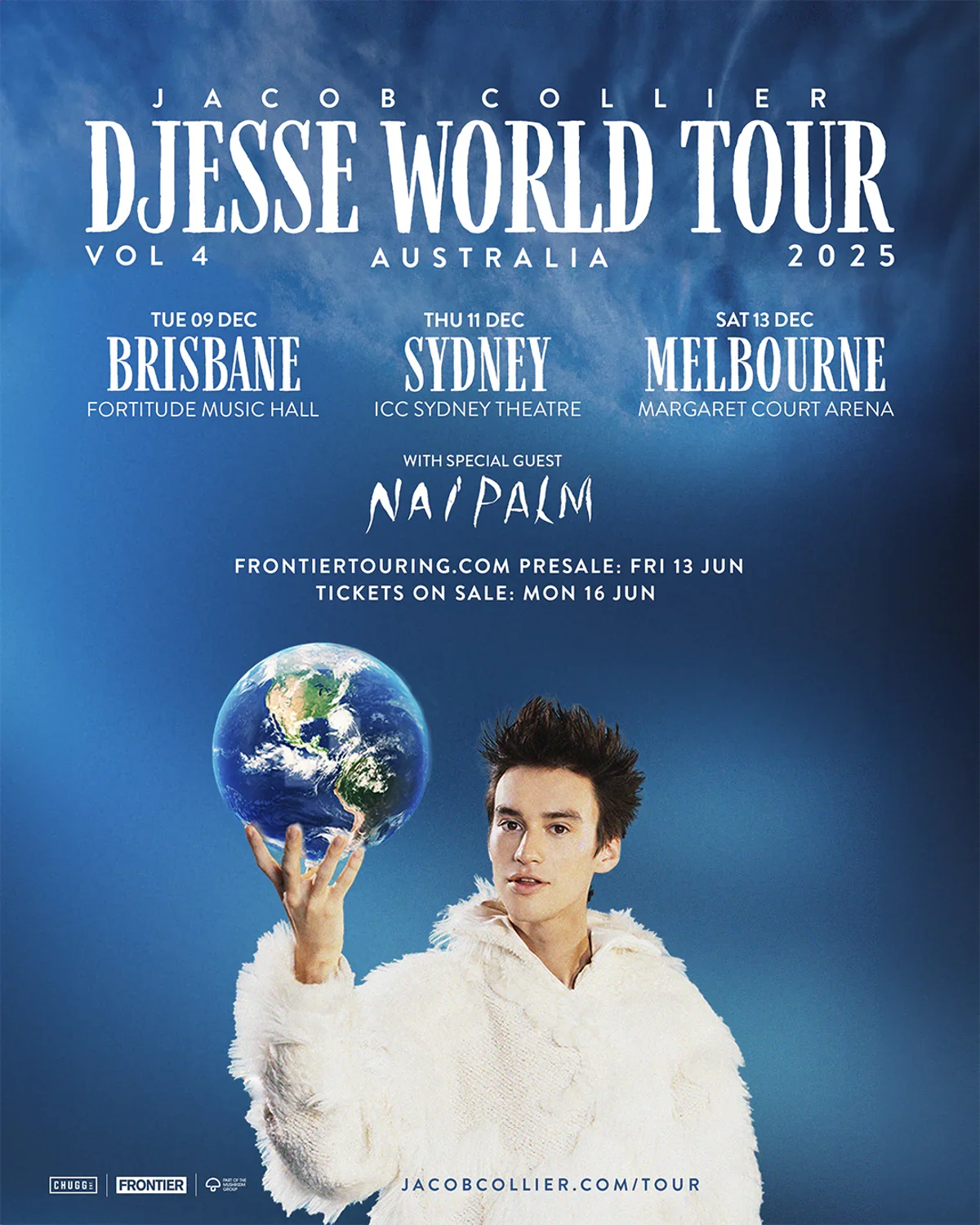
Jacob Collier - DJESSE Vol 4 World Tour
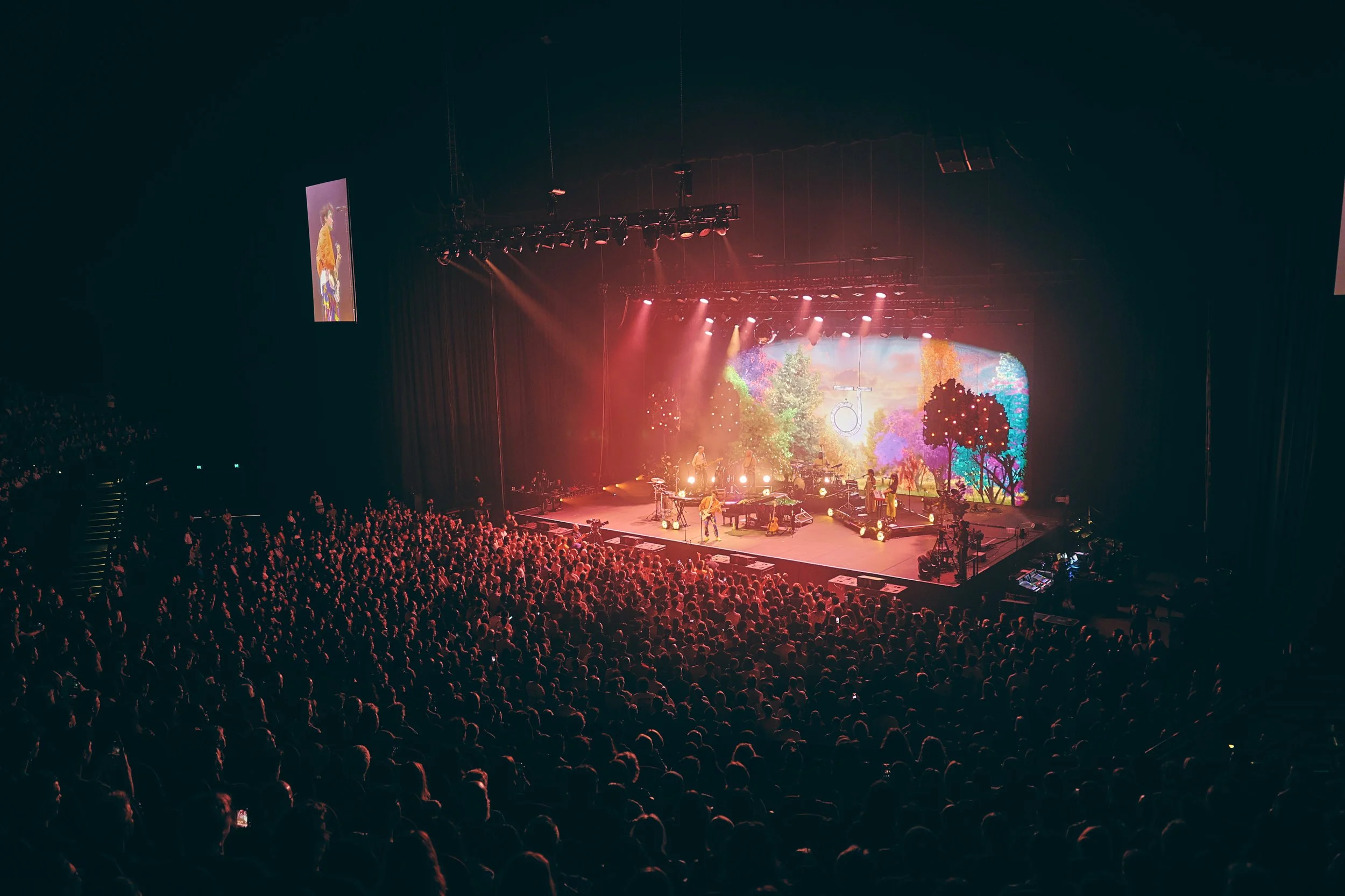
It’s hard to describe something that already feels a bit beyond language, but on a drizzly Thursday nigh tin Sydney, several thousand people tried anyway. Outside, the rain turned Darling Harbour into a mirror; inside the newly rebranded TikTok Entertainment Centre (still “the ICC” to almost everyone Jacob spoke to), the most eclectic crowd I’ve ever seen drifted into their seats. Kids who looked about nine, couples in their seventies, jazz nerds, pop fans, choir geeks, metalheads in band shirts, people in sensible cardigans and people dressed like walking album covers - it felt less like a typical gig and more like a world congress of music lovers. The stage itself only added to the intrigue: trees and shrubs clustered around a forest of instruments - grand piano, three keyboards, a full drum kit, a spread of percussion featuring a spiral cymbal, five guitars in various flavours - all under a huge glitter ball hanging above the front of the stage. Greens melted into pinks, reds into blues; the big screen behind flickered through dreamlike scenes that would later shift with every song, always complimentary, always responsive. Long before the first note was played, there was a hum in the room that said everyone knew they were about to see something special - even if none of us could quite explain what that “something” would turn out to be.
When the house lights finally fell, the front of the stage flushed pink, the back glowed deep blue, and Nai Palm strolled out with a guitar slung under her arm to a wave of cheers that felt more headline than support. She looked like she’d stepped sideways out of a graphic novel: almost knee-length lace-up boots, black leggings patterned with sparkly silver handprints, a t-shirt, and a reversed baseball cap perched over long, blonde hair that fell to her waist in loose waves, threaded with just a few plaits and flashes of green. Her feathered earrings and tattoos only added to the sense that this was someone who sees the world at a slightly different angle.
“Hi, my name is Nai Palm - I usually play with a band called Hiatus Kaiyote,” she said, grinning, “and tonight you’re gonna hear it all stripped right back.” One woman, one guitar… and somehow an entire universe. In her hands, that guitar became a rhythm section, a horn section, and a string quartet all at once. She thumbed basslines while throwing out rich, jazz-tinged chords, slid into little flurries of lead, peppered everything with shimmering harmonics that rang out like glass bells, and somehow still found space for silence. Over the top, that voice - deep and bluesy at the bottom, capable of weathered soul one moment and then floating into a fragile, airy falsetto the next. You could hear snatches of Hiatus Kaiyote songs, solo material and even a Hendrix cover, but she wasn’t just playing through the setlist; she was pulling the songs apart and rebuilding them on the fly, stretching phrases, bending time, leaving little pockets of air for the room to lean into.
Between songs she was disarming and funny. Early on she laughed, “Somebody just held their shoe in the air and asked me to sign their Croc - that’s a first!” Later, looking out over the sea of faces, she mused, “You guys are all adorable. I had a theory that all Jacob Collier fans would be cute - and you are.” It landed perfectly with this crowd, who rewarded every tune with huge applause and more than a few standing pockets. By the end of her set, the roar that followed her final chord was one of the loudest I’ve heard for a support in this city. “Shout out to Jacob for having me - thank you very much, Sydney,” she said, before slipping off… only to reappear a minute later seated cross-legged at the very front of the stage, calmly signing that now-famous Croc for its beaming owner. It was a tiny, human moment in a big, shiny room - and it set the tone for the night.
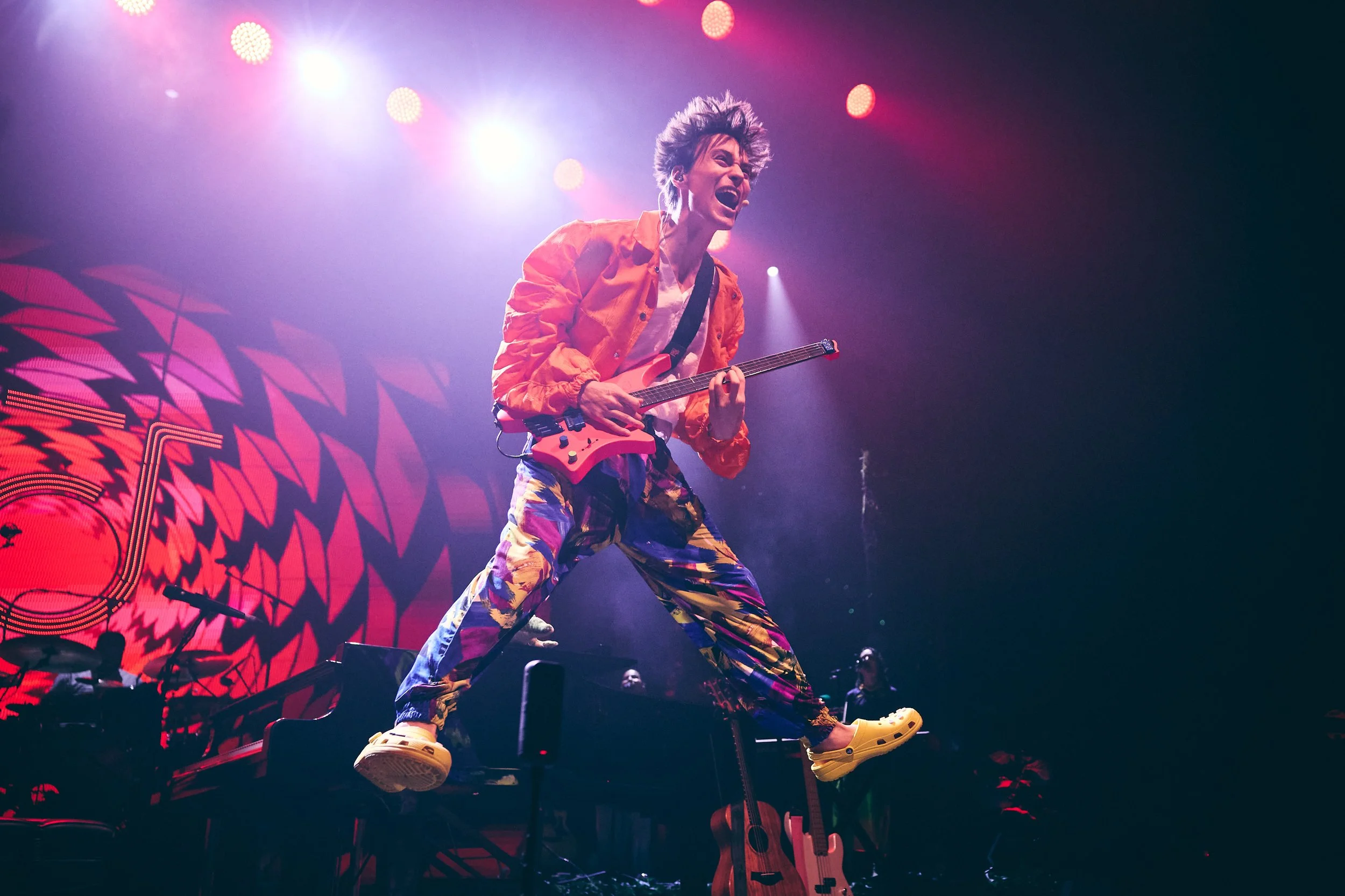
If Nai’s set felt like a spell, Jacob Collier’s entrance was the moment someone flicked the switch on the machine. He didn’t walk out so much as bounce onto the stage - a jolt of colour in an orange jacket, loose white shirt, blue-pink-yellow trousers and matching yellow Crocs, like a human highlighter pen who’d accidentally accumulated a shelf full of Grammys. Behind him, the video wall burst into life: a shifting collage of moonlit forests, galaxies, star trails and hearts that re-skinned themselves from song to song, always enhancing the moment rather than competing with it. Before we’d even had time to process the visual overload, he was already working on the sound.
The intro music - aptly, 100,000 Voices - became the foundation for something extraordinary. With a mischievous grin, Jacob coaxed the crowd into clapping and singing small motifs that quickly stacked into harmony. Within moments, seven thousand people were singing together, not tentatively but confidently, as if this were the most natural thing in the world. As the band slipped into place around him - Robin Mullarkey on bass, Ben Jones on guitar, Christian Euman on drums, Erin Bentlage and Parijita Bastola covering keys and vocals - Jacob moved to the grand piano and the show lifted cleanly into its opening run of songs from Djesse Vol. 4.
Very quickly, the emotional range revealed itself. One minute he was wielding a pink headless electric guitar, dancing across angular riffs while the band locked into a knotty groove; the next, he was back at the piano, leading the room through 100,000 Voices, the song literally built from recordings of crowds like this one. Between songs he spoke with humility and barely-contained wonder. “Welcome, Sydney - you look spectacular,” he said, scanning the room. “I’ve been excited about this moment for so long - for three years. I played the Metro, I played the Opera House, I played the Enmore… but this, this feeling? This is like nothing I can describe.”
Little Blue was the first time the entire arena seemed to collectively stop breathing. Jacob stepped out alone with an acoustic guitar, lit by a single spot at the lip of the stage. There was no band, no backing track, just his voice and a delicately picked pattern beneath it, and somehow the room shrank to the size of a small folk club. Halfway through, he drifted back to the grand piano and, as the lights slowly expanded, Erin took over the lead vocal with a tone so clear and unforced it felt like the lyric itself was doing the work. By the time the full band joined in, the song had grown from a lullaby into something widescreen and cinematic. For the final chord, Jacob divided the arena into three sections and taught each their note, conducting the room into a single, glowing harmony that seemed to ring through your chest as much as your ears.
Not everything went smoothly, which only made it better. At one point his headset failed mid-banter. “I’ve lost power to my headset - is there a headset mender?” he called out, pacing the stage until a tech sprinted over. “Give it up for the headset mender!” he laughed once it was fixed. “In honour of the headset returning, I’d like to play a funky song.” Seconds later, he had a five-string bass slung over his shoulder and dropped into Time Alone With You, anchoring the groove before bouncing back to the piano without missing a beat.
His cover of Bridge Over Troubled Water arrived like a modern hymn. The stage fell into deep blue, Jacob standing in white light at his Novation synth, layering vocoder harmonies that swelled and folded back on themselves like a digital pipe organ. Sometimes it sounded like a full choir, sometimes like a single voice multiplied endlessly. It was reverent without being heavy, and the response from the room said everything.
Midway through the set, Jacob spoke about a brief break before the tour. “I thought I’d write a couple of songs on my five-string guitar,” he said. “I accidentally ended up writing an album. Has that ever happened to you?” The laughter that followed said no - but we were glad it had happened to him. He explained how the guitar’s symmetrical tuning - D, A, E, A, D - opened up an entirely new musical language, letting him explore harmony and movement in unfamiliar ways. That language underpins The Light For Days, the album he then introduced, before beginning one of its songs with just voice and guitar beneath a night-sky backdrop.
That was when the evening tipped fully into the unreal. A voice from the crowd asked if he could join in. Jacob paused, then asked the question that changed everything: “Which instrument do you want to play?” He gestured broadly at the array of gear around him. Without hesitation, the fan - Matt - pointed at the five-string Taylor hanging around Jacob’s neck. The room erupted as Jacob handed it over, smiling. “That’s a very special guitar,” he said. “But I trust you.”
Before anyone could count anything in, Matt strummed a few confident chords, grounding himself. He then did something remarkable: he turned to the audience, divided the arena into sections, and assigned each group a note to sing. Jacob quietly stepped back to the grand piano, watching in amazement as this newly-minted bandmate took control. Before playing, Matt asked if he could film the moment. Given the nod, he calmly clipped a GoPro to the peak of his cap, tightened the strap, and then carried on as if this were the most natural gig in the world.
What followed was sensational. Matt didn’t just survive - he thrived. He navigated the song with confidence and musicality, even handling the lead flourishes with ease, while seven thousand people followed his cues. When it ended, Jacob asked gently, “Do you have a five-string guitar?” “No,” Matt replied. The reaction was thunderous. As he climbed back down into the crowd, already immortalised via GoPro footage, it felt like we’d all witnessed a once-in-a-lifetime moment - not because it was perfect, but because it was generous, trusting, and completely real.
Later, the focus shifted to rhythm. At the very front of the stage, Jacob stood behind his own percussion setup, trading patterns on piccolo snare, roto-toms and auxiliary pieces, tuning and shaping tones as he played. The grooves grew increasingly complex, with the crowd clapping, laughing and sometimes losing the beat entirely before finding it again. From there, the band slid into an instrumental passage that roamed through jazz, African, Latin and pop territories without ever feeling indulgent - just curious.
Somewhere in the middle of all this, Jacob introduced Jethro - a stuffed fabric crocodile he’d picked up on an earlier Australian visit, whose first gig had been sitting on his piano at the Sydney Opera House. Jethro has since travelled the world, appearing at every piano Jacob plays, and tonight was no exception. When the Croc made its second appearance for autograph duty, Jacob laughed and declared it “the easiest yes I’ve ever said,” sending it on another journey across the stage so the whole band could sign it.
Then came the moment that defied explanation entirely. Without any explanation, Jacob raised his hands and began conducting the audience. No instructions, no reassurance. And yet everyone knew exactly what to do. Different sections, different notes, different keys, new found and secret harmonies. People found their own voices - some, including me, for the first time ever - choosing notes instinctively, adjusting volume and tone, listening as much as singing. For four or five minutes, maybe longer, time seemed to stretch. Sounds rose and fell, swelled and dissolved, sections blooming and disappearing. It felt endless in the most beautiful way. When he finally closed his fists and brought the sound to nothing, the silence hung heavy before the arena erupted in a standing ovation that simply would not stop.
“In an ideal world I would stay up here and play a concert forever,” he said once he could speak again. “But we don’t have infinite time.” He introduced the band, the crew, the engineers, and noted that this was the 344th show of the Djesse 4 tour - the penultimate night, with the final show taking place in Melbourne on Saturday. He thanked Nai Palm again, thanked the audience old and new, and thanked Sydney simply for being Sydney.
The final songs drifted past like a dream. Box Of Stars Pt. 1 closed the night, the visuals dissolving into constellations as the band took their bows. Then the house lights came up, and reality gently returned.
Outside, in the damp air, you could hear attempts… attempts to describe that which cannot be described. One voice behind me laughed, “It’s like a gospel service, a jazz gig and a TED Talk all happening at once.” Nearby, the now-famous Croc owner was already plotting the next move. “If I can get tickets,” they said, “I’m doing a road trip to Melbourne tomorrow. I just need one more hit of that.”
And that, really, is the heart of it. You can analyse Jacob Collier’s theory, his harmony, his rhythmic sleight of hand. But until you’ve stood in a room where thousands of strangers become a choir without being told how, where generosity trumps perfection, and where music feels less like performance and more like shared discovery, it’s impossible to explain the magic.
Transcendent.
Thanks to Jacob Collier, Nai Palm, Frontier Touring, Chugg Entertainment and the TikTok Entertainment cntre for having us along.
Review by Andy Kershaw for Music Kingdom Australia