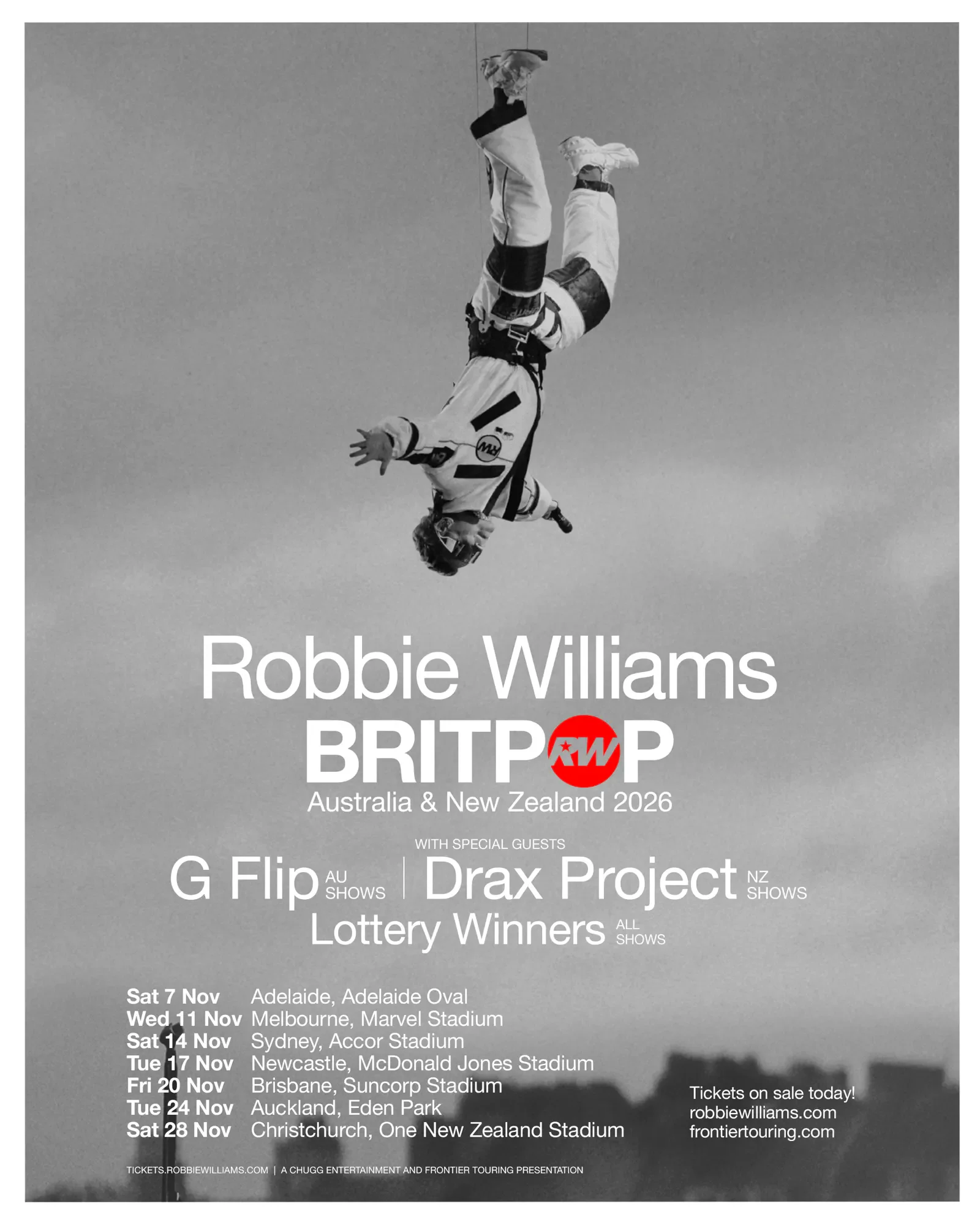
About 35 years ago, Robbie Williams walked onto the stage at my high school. Tonight, he arrived in a spaceship.
Sydney had decided to provide an additional supporting act for the evening, in the form of some rather persistent rain. But despite the weather, there was a wonderful sense of anticipation building around Accor Stadium as thousands of fans made their way inside, many of whom, like me, had spent much of their lives with Robbie Williams providing the soundtrack. The enormous stage dominated one end of the stadium, with towering screens, banks of lighting, and a long catwalk stretching deep into the crowd. As the evening progressed, the rain left the stage glistening beneath the lights, presenting a constant challenge for the performers and crew. The stage team deserve enormous credit for keeping the performance areas as dry as possible, the artists safe, and the show on the road. But looking around at the growing crowd, there was little doubt that everyone was ready for something special. And with two inspired choices of support act, the entertainment would begin long before Robbie made his entrance.
First up were The Lottery Winners, a four-piece indie-pop band from Leigh, Greater Manchester, fronted by the wonderfully charismatic Thom Rylance. Now, I know what you’re thinking. What’s Kaleb from Clarkson’s Farm doing fronting a band? But don’t be fooled by the resemblance. This bloke is a born entertainer. Despite achieving two UK number one albums, Thom was under no illusions about their relative anonymity in Australia. They were a pretty big deal back in Manchester, he explained, but for the next thirty minutes, could Sydney please pretend they were massive here too? In fact, he was going to leave the stage, come back on, and wanted everyone to welcome him as though he were “Robbie fucking Williams!” Off he went, returning moments later to an enormous roar. Clearly delighted, he considered venturing down Robbie’s catwalk, despite apparently being told he wasn’t allowed. “Fuck it!” he declared, taking a few determined steps forward, before noticing the rain and deciding the main stage was a much better idea.
It was that sort of performance. Hilariously self-deprecating, delightfully cheeky, and backed by some genuinely excellent music. After their opening number, Thom encouraged everyone to pretend it had been a huge hit. “Pretend it’s Rock DJ!” he laughed, before admitting that it most definitely wasn’t. He then began conducting some informal market research into the crowd’s favourite Robbie songs. She’s the One and Let Me Entertain You received enthusiastic responses, but when someone suggested Angels, Thom had an idea. Turning to guitarist Rob Lally, he asked whether he knew it. Rob began strumming, and Thom wondered aloud whether they might get into trouble. Then again, it was raining, Robbie wasn’t there, and perhaps they could sing it quietly. That lasted approximately three seconds before thousands of people took over. Suddenly, Angels had become the second song of the evening, and Thom was running back towards the main stage shouting, “I’m sorry, Robbie!”
Beneath the comedy was a cracking band, with punchy guitars, infectious melodies, and lovely harmonies. Rob introduced Much Better before Thom challenged the crowd to sing along as though it were already a stadium anthem. They obliged. Then came a more personal moment, as Thom reflected on struggling at school, being expelled twice, and genuinely believing he’d never amount to anything. Standing before this enormous audience, he asked everyone to applaud him, admitting with a grin that the appreciation felt wonderful, particularly in his belly and his willy! His heartfelt Letter to Myself, written for his twelve-year-old self and anyone who had ever doubted their own worth, was genuinely touching. They closed with Steady We Go, a beautifully melodic song with fantastic harmonies and a soaring guitar solo, which Thom confidently predicted would be a chart hit by the time they returned. Better than Ed Sheeran, apparently. And speaking of returning, they’re playing Sydney’s Manning Bar in April 2027. According to Thom, they’ve sold precisely one ticket. Robbie bought it. Well, after that performance, they can count on selling at least one more. I’ll be there.
Next came G Flip, and if The Lottery Winners had charmed the audience into submission, this remarkable Australian performer was about to give everyone a considerable shot of adrenaline. G Flip, born Georgia Claire Flipo, is one of those extraordinarily talented multi-instrumentalists who makes you wonder whether the rest of us have been wasting our lives. With Sophie Giuliani on guitar and Benji Ellingworth behind an enormous, bright pink double-bass-drum kit, the trio launched into Disco Cowgirl with a thunderous opening. Sophie wasted no time heading down the catwalk to deliver a blistering guitar solo, while G’s powerful vocals filled the stadium. And what a sound! Stadium acoustics can be rather hit-and-miss, but tonight the production team had absolutely nailed it. The drums had real weight, the guitars were enormous, and the vocals were crystal clear, occasionally reminding me of the scale and clarity Queen used to achieve in stadiums decades ago. Not bad for three musicians.
G Flip is also an extraordinarily physical performer, seemingly incapable of standing still for more than a few seconds. One moment G was commanding the stage during the sultry, powerful GAY 4 ME, the next, picking up a saxophone to introduce the driving I Don’t Wanna Regret. During Drink Too Much, G climbed down into the pit, high-fiving fans pressed against the barriers, before racing back across the stage. Then, with a guitar slung around the neck, G began Good Enough, delivering a beautifully restrained opening verse before handing the instrument to a technician, climbing behind the drums, and launching into the explosive second half. All while continuing to sing. And this wasn’t some singer occasionally having a bash at the drums. G Flip is a seriously accomplished drummer who subsequently became a successful singer and songwriter, and that musical foundation is at the heart of the performance. Watching G switch effortlessly between instruments, without losing any vocal power or connection with the audience, was quite something. Is there anything this performer can’t do?
There was a lovely personal moment when G spotted someone special in the audience: former high school music teacher Gavin Cassidy, who happened to be celebrating his birthday. G explained how much Gavin’s encouragement and teaching had meant, and how instrumental he’d been in helping turn a love of music into a career, before leading the stadium in Happy Birthday. It was a touching acknowledgement of someone who had clearly made a lasting difference. Then it was back behind the drums for a fantastic, thunderous rendition of Taylor Swift’s Cruel Summer, which had the crowd singing along enthusiastically, before continuing into The Worst Person Alive. Sadly, the increasingly wet conditions meant the set had to finish early, robbing us of the planned finale, Bed on Fire. A real shame, because G Flip had been absolutely on fire. Two very different support acts, both overflowing with talent, energy, and personality. It wasn’t difficult to see why Robbie had chosen them.
And then it was time for the man himself.
I first saw Robbie Williams about 35 years ago, when Take That visited my high school in the north of England to promote their first single. There was no way of knowing, watching that young lad perform in front of a hall full of schoolchildren, that I was witnessing the early days of someone who would become one of the finest entertainers of his generation. Now we’re both 52, although only one of us has maintained the sort of energy that would make a twenty-year-old feel inadequate. I had come expecting something flamboyant, extravagant, hilarious, and completely over the top.
Robbie didn’t disappoint.
The show began with a clever video exploring two possible futures for music in the age of artificial intelligence. In one, AI threatens to replace the human imagination and creativity at the heart of music. In the other, it becomes an extraordinary tool, opening new possibilities for artists. But the film suggested that Robbie Williams would somehow transcend either outcome.
“He’s not a man, he’s a signal. You don’t watch Robbie Williams, you tune into him.”
Quite a statement. And as the band took their positions and the opening notes began to build, we were about to find out what that meant.
Robbie appeared wearing a futuristic silver spacesuit, surrounded by old-fashioned microphones, climbing a towering yellow staircase that formed part of an enormous spacecraft-like structure. As he launched into Rocket, the entire contraption began to rise, with fountains of brilliant white sparks cascading towards the stage below. Smoke billowed through the lighting, the band thundered away beneath him, and the whole scene resembled something halfway between a science-fiction blockbuster and an extremely expensive midlife crisis. As the spacecraft reached the top of its ascent, Robbie began his descent, suspended horizontally, floating headfirst towards the stage, before landing on his feet with all the grace one could reasonably expect from a 52-year-old pop star returning from orbit. Off came the spacesuit, revealing bright red trousers with white stripes and a matching red singlet.
And then came Let Me Entertain You.
The stadium erupted. Robbie commanded the stage as though he’d never been away. Halfway through, he paused to reintroduce himself. “I’m Robbie fucking Williams. This is my office, this is my band. You better be fucking good, because I’m fucking phenomenal!” It was outrageous, delivered with that familiar mixture of enormous ego and mischievous self-awareness. And within minutes, it was difficult to disagree.
“Have you missed me, Sydney?” he demanded, before pointing out that it had taken him twenty bloody years to get back into this stadium. He then casually mentioned spotting someone earlier in the day whom he’d slept with twenty years ago. You could almost hear the audience imagining some glamorous former girlfriend. Apparently, he almost hadn’t recognised them. The reason? “He’s got a beard now!” And, Robbie assured us, the gentleman had been very gentle with him. “He broke me in nicely!” The punchline landed beautifully. It was going to be that sort of night.
Robbie described the evening as his love letter to entertainment, then began questioning whether he was still any good at it. Had his best days passed? Was he merely the fat dancer from Take That? The audience answered every question with a resounding no. He explained that he didn’t perform for money or glory. He had four children, all by the same woman, he proudly added, and quite frankly, he just wanted to get out of the house. By now he’d acquired an enormous red faux-fur coat, which looked spectacular for approximately the first verse of Rock DJ, before he decided Sydney was far too bloody hot for it and handed it to a stage technician. “Bloody hell, he’s still got it!” someone nearby remarked. They weren’t wrong.
During Strong, Robbie tested the crowd’s knowledge by singing the opening lines before allowing thousands of voices to take over. He wandered down the damp catwalk and climbed onto the barrier, sitting among his fans, singing directly to them, and looking completely at home. For all the scale of the production, this was where his greatest talent became apparent. He has an almost uncanny ability to make an enormous stadium feel like a gathering of old friends.
He then announced that he wanted to film a video for a new song, Pretty Face, from his BRITPOP material. Now, he acknowledged, when a 52-year-old bloke announces he’s going to sing something new, the audience’s usual response is something along the lines of “Oh, don’t go doing that, Robbie!” But he needed everyone to get their phone torches out and pretend it was the best new song they’d ever heard. The stadium obliged, thousands of tiny white lights appearing across the stands. In fairness, the song had all the familiar ingredients of a Robbie anthem, with a big chorus and plenty of swagger. He repeatedly asked whether everyone loved it, then congratulated Sydney on doing such an excellent job of pretending. The footage was going on the internet, apparently. Robbie had made us part of the joke, and we loved him for it.
But underneath the enormous personality, there’s another side to Robbie Williams, and it began to emerge as he spoke about his film and the first 27 years of his life. He joked that the audience had apparently thought it better than all three Godfather films and The Shawshank Redemption combined, before becoming more reflective. He explained that his life hadn’t truly begun until he met his wife, Ayda, who had given him four beautiful children. They weren’t interested in the fame, fortune, or adoration. They simply wanted their dad to be there. Robbie spoke affectionately about the woman he credits with saving his life, dedicating Love My Life to his wife and children. As the song swelled towards its conclusion, brightly coloured streamers exploded over the audience, filling the air with ribbons of red, yellow, blue, and green. Against the glowing stage and thousands of raised hands, it was a spectacular sight.
The mood lifted again with Hot Fudge, a song Robbie admitted he’d been reluctant to include until musical director and drummer Karl Brazil insisted. Apparently, Melbourne had enjoyed it, although Robbie wasn’t entirely convinced that meant Sydney would. Within seconds, any doubts had disappeared, particularly when he substituted Sydney for LA in the lyrics. Karl was informed he’d managed to keep his job. Then came Supreme, beginning with Robbie singing alone before the band swept in behind him. The outstanding backing vocalists, Sara Jane Skeete and Elle Cato, joined the musicians near the catwalk, adding rich harmonies to the soaring guitars, driving bass, and a playful keyboard nod to I Will Survive.
The next story revealed just how far Robbie had travelled to be standing on that stage.
He spoke about his decision to stop drinking some 26 or 27 years ago. It hadn’t been an act of casual self-improvement, but a decision he believed had saved his life. He told us frankly that he’d been on a path that would have killed him. Those early weeks and months had been desperately difficult, full of anxiety, uncertainty, and the terrifying prospect of discovering who he was without alcohol. He recalled sitting on the edge of his bed, wondering how he was going to survive and what he would do with his life. It was during that dark period that he wrote The Road to Mandalay. Suddenly, a song that might not be among the first people mention when discussing Robbie’s greatest hits carried a very different weight. Here was a man who had once feared he wouldn’t survive, now standing before an enormous crowd who had followed him through much of his life.
As the song continued, Robbie stepped into the pit and began walking through the audience, accompanied by a joyous procession of musicians and backing singers, complete with guitars, bass, marching drums, and brass. They gradually made their way towards a small circular stage much closer to the middle of the stadium. Robbie explained that he’d watched Coldplay and noticed they had a C-stage, so naturally he decided he wanted one too. Then he noticed Coldplay’s illuminated wristbands and asked his tour manager whether he could have those as well. Apparently, it would cost him ten dollars per audience member. “Fuck that!” was the predictable response. Everyone had phones, didn’t they?
And so, with thousands of phone torches illuminating the stadium like an enormous galaxy of stars, Robbie began Better Man. Every tier, every section, and almost every corner of Accor Stadium twinkled with white light. It was breathtaking. Robbie even changed a lyric to suggest he was doing everything he could to become Australian, drawing another enormous cheer. Afterwards, he reminded us that Better Man had only ever been a hit here, something he still seemed genuinely delighted by.
He then explained that he wasn’t entirely sure which of his songs had been the biggest hits in Australia, so he needed to conduct a little audience research. He began singing familiar lines, and the crowd enthusiastically completed them. Then he announced that he had a special guest to help.
Remember Thom from The Lottery Winners?
Well, Thom had warned us earlier that Robbie would be inviting him back onstage, and asked everyone to give him an absolutely ridiculous reception, preferably so enthusiastic that it would really annoy Robbie. The audience had clearly been paying attention. When Thom appeared, the roar was enormous. Robbie looked genuinely bemused. Why was someone who hadn’t even had a hit in Australia receiving that sort of welcome? He assured Thom that his time would come, before the two settled into a delightfully relaxed acoustic session, moving through fragments of Tripping, Angels, Feel, Sexed Up, and Candy. It felt almost like two mates sitting around in a pub with a guitar, except their pub happened to contain several thousand additional customers.
Then Thom announced that he knew an even bigger Robbie hit and began strumming Wonderwall. Robbie immediately protested that it was an Oasis song, prompting a hilarious story about how, following the band’s split, he’d telephoned Noel Gallagher and offered to become their new lead singer. He’d promised Noel he wouldn’t cause any trouble whatsoever. Noel apparently laughed and hung up. Thom pointed out that Robbie didn’t need Noel’s permission to sing the song in Sydney. He needed Sydney’s. The crowd enthusiastically granted it, and before long everyone was singing along.
As the acoustic section drew to a close, Robbie reflected on the rumours that tend to circulate about famous people. He’d like to start a nice one for a change. If anyone asked how the concert had been, could they simply say that he was a nice man? It was a surprisingly modest request from someone who had spent the previous hour reminding us how phenomenally talented he was. Then came a beautifully restrained opening to Something Beautiful, which gradually blossomed as the full band joined in and Robbie made his way back towards the main stage.
The spectacle returned for Millennium. Eight dancers appeared in shimmering gold, their enormous gowns concealing raised platforms that made them look as though they were gliding effortlessly across the stage. Bathed in golden light, the scene resembled a lavish old Hollywood production, providing the perfect distraction while Robbie disappeared for another costume change.
He returned looking utterly ridiculous.
Dressed in an extravagantly frilled hot-pink outfit, Robbie settled behind a piano, complete with a banana, which he proceeded to eat while explaining that he needed a little energy for the next section. As you do. Then, with all the confidence of a Las Vegas lounge legend, he launched into a theatrical rendition of Theme From New York, New York. Gradually shedding the frills to reveal a sharply tailored pink suit over a black singlet, he strode downstage looking every inch the sophisticated showman. At least until he realised his flies were undone. He dealt with that little wardrobe malfunction with a laugh, before moving into the darker, James Bond-like atmosphere of No Regrets.
One of the most enjoyable parts of the evening came when Robbie introduced his band, although naturally, he couldn’t simply do it conventionally. Instead, he invented a game called “Shit or Not”, in which each musician performed a snippet of another artist’s hit while the audience decided whether they were any good. Guitarist Tom Longworth gave us Man! I Feel Like a Woman!, Jerry Meehan’s bass thundered through Another One Bites the Dust, and Karl Brazil delighted the audience with Down Under, which quickly became a mass singalong. Elle Cato and Sara Jane Skeete delivered a magnificent You’re the Voice, the Hot City Horns brought the party with Y.M.C.A., and Owen Parker treated us to Never Tear Us Apart. Finally came Gary Nuttall, Robbie’s longest-serving band member, who has been with him since 1997, performing and singing a fabulous rendition of Hey Jude. Robbie couldn’t resist joining in with the vocals throughout, turning the introductions into a collection of classic rock and pop favourites. Every musician was outstanding, and quite clearly, none of them was shit.
Not content with judging his musicians, Robbie decided to test the audience as well. During Come Undone, he ventured back into the crowd, singing a line before holding the microphone towards individual fans and challenging them to complete the next. Most rose magnificently to the occasion, although one rather bewildered-looking gentleman appeared to have been dragged along by his partner and wasn’t quite as familiar with the material. Robbie made the most of it. Eventually, he returned to the stage and the band launched into the full song, the crowd roaring its approval when Robbie asked whether Sydney still considered him one of their own.
Then came Kids, a wonderfully energetic performance featuring Elle and Sara Jane absolutely smashing the female vocals, while the dancers filled the catwalk and the Hot City Horns sounded magnificent. With the lights flashing and the whole band firing on all cylinders, it was impossible not to be swept along.
And then came something rather special.
Robbie climbed down towards the front barrier and began chatting with a woman named Emily, from Sydney. He explained that it would be terribly rude to ask her age, so naturally, he asked how much she weighed instead. Having established that they were now firm friends, he dedicated She’s the One to her.
What followed was genuinely beautiful.
Robbie began singing almost unaccompanied, with the piano gently picking out the melody before the rest of the band gradually joined in. Sitting on a stool at the front of the stage, he looked down at Emily, who stood at the barrier smiling up at him, singing every word. Their eyes barely left each other. Around them, thousands of voices carried the chorus into the night. At one point, Robbie looked at her and quietly pointed out that everyone was singing for her.
And they were.
For a few minutes, the enormous stadium seemed to shrink to the space between a singer and one very fortunate fan. Emily’s smile said everything. Robbie seemed just as touched, holding her gaze as he sang, while thousands of people shared in something that somehow felt remarkably private.
When the song finished, he immediately broke the spell by announcing that he’d just made more eye contact with Emily than he had with his wife in the past ten years. Classic Robbie. But I suspect Emily will remember those few minutes for the rest of her life.
By now, we’d laughed, danced, and sung our way through decades of music, with Robbie sharing stories of the people and experiences that had shaped his life.
But he had one more story to tell.
Robbie began speaking about a singer he’d admired for as long as he could remember. A wonderful performer, a man with an incredible voice and a natural gift for entertaining people. Someone he’d watched with complete admiration, dreaming that one day he might stand on a stage and sing just like him. This man had been his inspiration, the person who made him want to become a singer in the first place. Even after everything Robbie had achieved, the records sold, the enormous stages, and the millions of fans around the world, this man remained his hero.
And that man was his father, Peter Williams.
Here was one of the most successful British entertainers of his generation, standing before an enormous Australian audience, telling us that the man he’d always wanted to be like was his dad.
Robbie explained that Peter had been diagnosed with Parkinson’s disease in 2020, and that over the years his condition had progressively restricted his ability to leave the house. In fact, Robbie told us that his father had only left home three times in the past two years.
Every one of those occasions had been to watch his son perform.
Just imagine that for a moment. A man whose love of singing had inspired his little boy to follow in his footsteps, now struggling with a cruel illness, making the enormous effort to leave his home simply to see that boy, now a global superstar, standing on stage doing what they both loved.
Robbie described looking down from the stage and seeing his father watching him, with a proud smile that seemed to say, “I’ve done my job.”
He then recalled the times they’d sung together, and a particularly touching conversation just before one of those performances. Peter had turned to him and said something along the lines of, “God made me pretty good, but he made you the best in the world.”
You could hear the emotion in Robbie’s voice as he shared the memory.
And then, after a pause, that familiar cheeky grin returned.
“And you know what? My dad was right!”
The audience laughed, but this time the laughter carried a different warmth. It was a little release of emotion after a story that had clearly touched so many people.
Robbie looked out across the stadium and dedicated the next song to his daddy.
My Way.
It was an inspired choice. As the opening notes filled the stadium, the enormous screens began showing photographs of Robbie throughout his life. There he was as a little boy, then as the cheeky teenager who joined Take That, through the extraordinary highs and lows of his solo career, and eventually into the family man standing before us tonight.
Then came photographs of his wife and children, whom Robbie introduced one by one, sharing little stories and obvious affection for each of them.
The arrangement swelled, the lighting softened, and Robbie’s voice rose above the band with a richness and conviction that made every word count. This was a song he’d watched his father sing, a song that had inspired him to become the performer he is today. And now, after everything life had thrown at him, he was singing it back to his dad, in front of thousands of people who had travelled much of that journey with him.
Looking around, it was clear that I wasn’t the only one feeling the emotion. This was no longer simply a concert. It was a son paying tribute to his father, sharing a lifetime of memories, gratitude, pride, and love.
And when he reached the final notes, it felt as though the entire evening had been building towards them.
Robbie thanked Sydney for taking him into its heart, told us we’d been phenomenal, and wished everyone goodnight. The lights dimmed, and for a moment, the stage fell quiet.
But nobody was ready to leave.
The applause grew louder, the cheers continued, and it wasn’t long before Robbie returned, wearing a shiny red sports shirt emblazoned with the number 74, the year of his birth, and proudly declaring his National Treasure status. The piano gently introduced Feel, with Robbie singing the opening verse before leaving the chorus to the audience. These weren’t simply songs people remembered from the radio. They were the soundtracks to relationships, friendships, celebrations, heartbreaks, and years gone by. And here we all were, singing them together with the man who had created so many of those memories.
Robbie spoke again about his love for Australia. Boarding a plane to come here always felt like coming home, he said, and if there was a God, next time around he’d quite like to come back Australian. It was delivered with his usual humour, but there was unmistakable sincerity behind it. He thanked his band once more, looked out across the stadium, and asked a simple question.
“Well? Do you want to do it?”
Of course we did.
As the opening notes of Angels rang out, thousands upon thousands of phone torches rose into the night sky.
And suddenly, Accor Stadium was transformed.
Every tier of seating glowed white, the entire floor shimmered with tiny lights, and the stadium became a vast, illuminated sea of people singing together. Looking across the crowd, it was almost impossible to take in the scale of it. Tens of thousands of individual lights, each one held by someone who had come to share this night, all moving gently beneath the dark Sydney sky.
“And through it all…”
The crowd took over, their voices rising together until the whole stadium seemed to be singing as one. You could feel it as much as hear it.
But what struck me most wasn’t the spectacle. It was Robbie.
He wandered slowly across the stage, looking out into different sections of the audience, taking it all in. On the giant screens, you could see something quite different from the outrageous, swaggering showman who had arrived in a spaceship a couple of hours earlier.
He looked genuinely moved.
There was a softness in his expression, a hint of disbelief, perhaps even a tear in his eye. He seemed almost humbled by the sight of so many people singing his song back to him, as though after all these years, all the success, and all the extraordinary things he’d experienced, he still found it difficult to comprehend just how much he meant to the people standing before him.
And in that moment, you realised just how much they meant to him.
As Angels reached its glorious conclusion, Robbie stood alongside his band and dancers to take a final bow, receiving a standing ovation that felt less like a polite thank-you and more like an outpouring of genuine affection.
I stood there thinking about the young lad I’d watched perform at my school all those years ago, and the remarkable journey he’d been on since. The cheeky, slightly rebellious boy from Stoke-on-Trent had grown into an extraordinary entertainer. At 52, he looks fantastic, his voice is still powerful, his comic timing impeccable, and his energy seemingly limitless. He’s still gloriously inappropriate, outrageously flamboyant, and more than capable of commanding an enormous audience with a single raised eyebrow. Yet he’s also vulnerable, affectionate, and refreshingly open about the things that have shaped him.
The evening had begun with a film suggesting that artificial intelligence might one day reshape the entire music industry, perhaps even challenging the very nature of human creativity. But after witnessing what Robbie Williams delivered tonight, I couldn’t help thinking that no machine, however sophisticated, could ever truly replicate what we’d experienced. You could reproduce the songs, imitate the voice, generate the images, and perhaps even recreate the spectacle. But you couldn’t manufacture that connection between Robbie and Emily, the pride in his voice when talking about his father, or the look on his face as thousands of people sang Angels back to him. You couldn’t recreate the shared memories, the laughter, or the affection that filled that stadium. Early in the evening, Robbie had confidently informed us that he was fucking phenomenal. By the end, he’d provided more than enough evidence to support the claim. For all the extravagance and spectacle, Robbie Williams reminded us that the very best entertainment isn’t simply something you watch. It’s something you feel, something you share, and something that stays with you long after the lights have gone down. National treasure? Absolutely. But I think we’re selling him short. Robbie Williams is a global treasure, and one of the finest all-round entertainers I’ve ever had the pleasure of seeing.
Some signals fade with time. About 35 years on, Robbie Williams is still coming through loud and clear.
Thank you to Robbie Williams, Frontier Touring and Accor Stadium for having us along.
Review by Andy Kershaw for Music Kingdom Australia