Ed Sheeran - Loop Tour
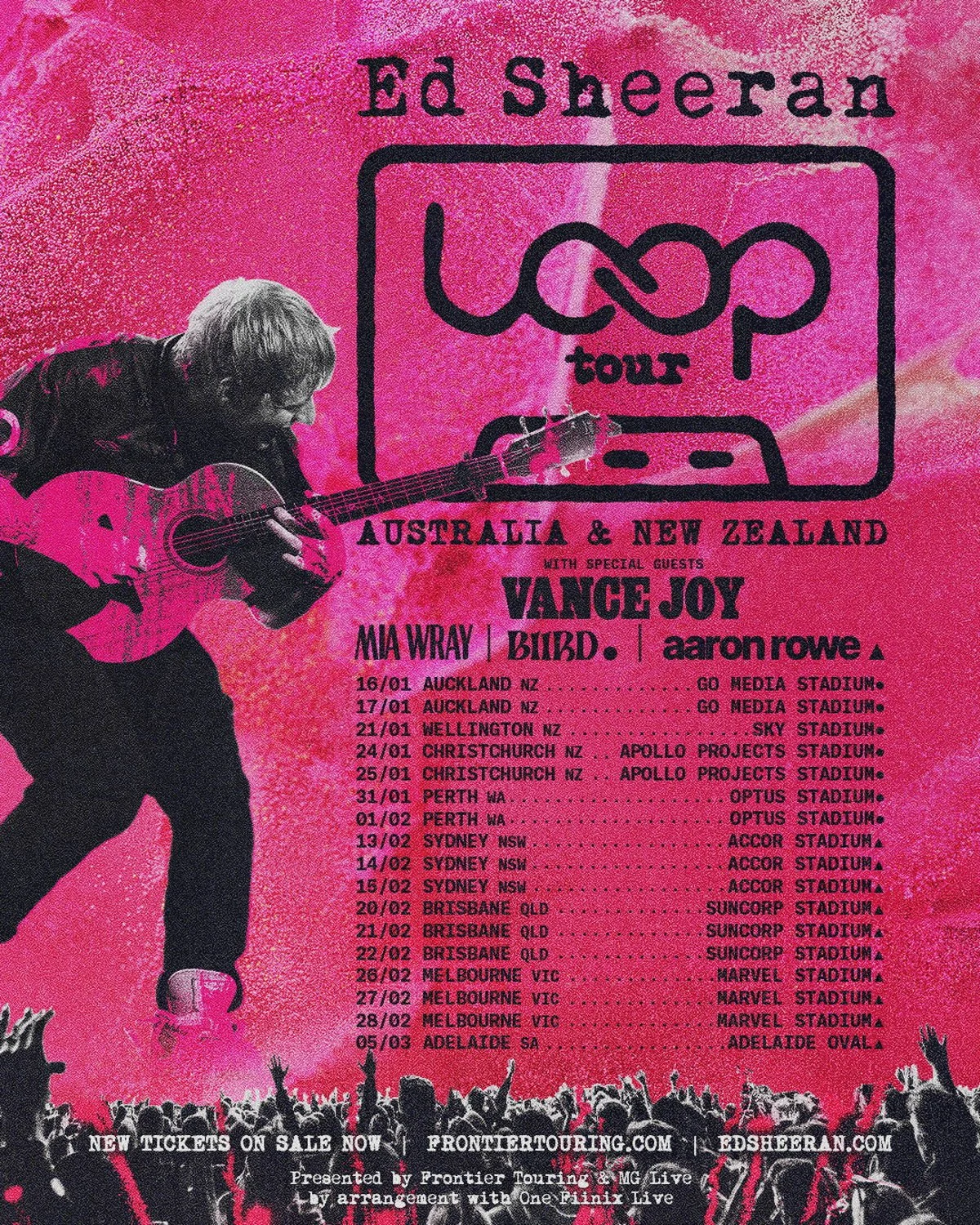
Seventy thousand people, one bloke, a guitar and a loop pedal.
Valentine’s Day at Accor Stadium felt like standing inside a held breath. The rain had threatened all afternoon but never quite committed, leaving the air thick and electric as fans streamed in from every direction. Pink Ipswich Town shirts mingled with homemade tour tees. Kids on shoulders. Groups in fresh merch taking selfies like they were already in the highlight reel. Accents from every corner of the world. By the time the sun began its slow descent, the stadium had that peculiar hum that only comes when everyone knows something big is about to happen.
AARON ROWE walked out into that vast bowl of concrete and steel with no fanfare, just a guitar and a thick Irish accent that somehow stayed intact even when he sang. The stadium was still finding its seats, but his voice cut through with warmth and grit as he opened with DRAWING THE LINE. “They do all the hard work. We just come up here and sing songs,” he said, urging applause for the security guards, bar staff, sound engineers and crew before sliding into PLEASE DON’T HATE ME, reflective and raw in a way that made the room feel smaller.
He dedicated TALKING WITH YOU to his eighty year old uncle back home, his best mate, and suddenly the biggest room he had ever played felt personal. “I’m from Ireland, but I love Australia,” he beamed, and you could tell he meant it. Then came that cheeky pivot. “Happy Valentine’s Day to all you couples,” he grinned. “This next one’s not for you.” LOSE LOSE landed with a wink and a sting. By the time he asked, almost shyly, “Do you mind if I do one last song?” before HEY MA, he had already won them over. A rising talent, visibly buzzing to be there, and playing like he knew he belonged.
MIA WRAY took the stage as the afternoon softened. The stadium was fuller now, the crowd more settled, the noise more intentional. She opened with the slow burn of WORK FOR ME, letting the melody unfurl rather than chasing a big moment. Then the band kicked into STAY AWAKE and everything lifted. Guitar, bass and drums gave her voice a runway.
When she picked up the acoustic and introduced NOT ENOUGH, a song written as she was coming to terms with her sexuality, she didn’t dress it up or turn it into a speech. She just told the truth, and let the song do the heavy lifting. Later, she moved to the piano and offered MONSTER BRAIN for anyone struggling, “especially on Valentine’s Day.” A woman in front of me turned around, eyes wide, pointing toward the stage. “She’s got a beautiful voice.” Nobody in that stadium could disagree. The set finished on THE WAY SHE MOVES, building and building until it felt like a giant cinematic wave. Bass and drums pushing, guitar slicing through, her voice right at the centre of it. Huge applause. The kind that says, we did not expect that and we’re glad we got it.
Then VANCE JOY arrived like an old friend you forgot you missed. “We’re very happy to be opening for our friend Ed Sheeran,” he said, smiling at the size of the place, and he kicked off with MISSING PIECE. His voice has that rare quality where it can sound intimate even when it’s bouncing off concrete tiers. MESS IS MINE brought the claps, and the crowd took the cue quickly, like they’d been waiting all day for permission to join in.
He played a new one, DIVINE FEELINGS, telling the story of meeting his wife and that strange, weightless feeling when you know it’s right but have no idea where it’s going. Then came one of those little Vance moments, disarmingly human. He talked about getting songwriting help from his mum, and how one morning at breakfast she offered him a line: “Everything is fine when your head is resting next to mine.” A few months later it became the seed of FIRE AND THE FLOOD. Trumpet soared. Sax answered. The crowd sang the chorus back at him and it was the first proper stadium sized singalong of the night, the volume suddenly stepping up like someone had pushed a fader.
“How’re you guys feeling?” he asked, and the roar told him everything. He spoke about Saturday crowds being special, about coming out after a good day to have a great night, and SATURDAY SUN felt perfectly timed. People started standing, dancing, swaying in place. For a moment the band stepped away and left him alone with an acoustic guitar, and he did what he always does best. He made the place feel like a backyard. Then he set up a joke with a straight face. “Yesterday was Friday the 13th, which is a spooky day,” he said, pausing just long enough for the crowd to lean in. “Valentine’s Day can be a spooky day too, if you’re afraid of commitment.” That was Sam’s gag , he told us, and he had “permission to use it.” Groans, laughs, a few cheers. Exactly right.
By the time he asked for phone lights in the last chorus of GEORGIA, golden hour had arrived properly, and the stadium glittered in soft, trembling points. He thanked Ed again, called him an inspiration, and then threw in a cover that shouldn’t have worked but absolutely did. I WAS MADE FOR LOVING YOU, powered up by trumpet and sax and a bit of guitar swagger, turned into a full stadium grin. And when he closed with RIPTIDE, the whole place sang the chorus unaccompanied for a moment, the band just smiling at the sheer scale of it. It didn’t feel like an opening act anymore. It felt like the night had already started and we were all in.
That’s what made the lead in to ED SHEERAN so potent. Because by the time the main screen flashed into vivid pink, LOOP TOUR stamped inside a cassette with liquid movement pulsing behind it, the crowd wasn’t just waiting. It was primed.
The clever trick of this tour is that the setlist is partly in the hands of the crowd. A QR code appears, people scan, songs get voted in, and the show becomes a little different each night. But the other trick is the staging, because for all the cinematic scale, the setup is surprisingly sparse. Two stages, yes. A huge main stage up front and a circular B stage out in the crowd, about fifty metres closer, like a lighthouse in a sea of people. But on those stages there isn’t a band wall or a forest of instruments. There’s space. A mic. A guitar stand. A keyboard waiting its turn. And always that loop station, the beating heart of the whole thing. The contrast is almost funny. You’re staring at one of the biggest screens you’ll ever see and a runway bridge that can glide above the crowd, and the centrepiece is still a bloke building songs with his hands.
A video played with Ed explaining how every show is recorded live and no two nights are the same. While the crowd watched the screen, security quietly walked him into the stadium. Then, like a magic trick, the cameras lingered on the B stage and the roar hit before most people even saw him.
ED appeared on the elevated circular B stage to an eruption of noise and opened with YOU NEED ME, I DON’T NEED YOU. Not easing in. Not warming up. Straight into it. Looping, rapping, stamping rhythms into the night like he was back in a tiny room. And then, mid song, the bridge extended from the main stage, sliding above the crowd toward him with this smooth, silent confidence that made everyone around me gasp. He walked across it without missing a beat, rapping as he went, the crowd losing its mind beneath him, and finished the song on the main stage as if this sort of thing happens every day.
The production was immense. Not just big, but smart. The screen didn’t simply show him. It played with him. Live video blended into graphics. Visuals synchronised perfectly with the loops. Sometimes it was pure clarity, just ED, close enough to see the expression on his face. Sometimes it was like he was performing inside the artwork.
He grinned and threw down the challenge. “Until last night Perth was the loudest night on the tour,” he said, letting the crowd boo Perth in the friendliest possible way. “But last night Friday night in this very stadium, Sydney came alive. Tonight’s Saturday night. I don’t need you to sing along with me, or be in tune. I need you to scream along with me and wake up without a voice. If someone asks, ‘how was the show,’ and you don’t say ‘AMAZING’ with a hoarse voice, I haven’t done my job, Sydney.” And then he went straight into SAPPHIRE, which had to be restarted when the complex rhythms fell out of time. It was a blink and you’d miss it reset. But it mattered, because it reminded everyone that what we were watching was real.
CASTLE ON THE HILL turned the stadium into a bouncing organism. Pyro hit in time with the chorus. Flames burst from above the screen. People jumped like they were nineteen again. A bloke behind me yelled, “This is ridiculous,” with the kind of joy that made it a compliment.
Then he brought the mood down, not by slowing the show, but by taking us back. He spoke about Australia being the first place outside England to show him and his music love, about early days in Sydney, and then he went to THE A TEAM, written when he was eighteen and played to too many empty pubs in London. The effect in a stadium is strange and powerful. A small, fragile song becoming enormous because tens of thousands of people are holding it gently. And here’s the thing. The phones came out without him asking. This was the brightest I’ve ever seen a stadium lit by phone torches. Not because he told us to. Because we all felt what it was asking for.
He talked about starting out with a loop pedal in his backpack, playing pub gigs in London, and how the pedal has grown now, custom made, but it still does the same thing. “Everything is recorded live,” he reminded us, before launching into SHIVERS, a song practically built for the looper. Beats, harmonies, riffs stacking on top of each other, him moving seamlessly back out to the B stage on the bridge so he could sing to every angle of the stadium. Truly in the round, truly shared.
There was a quiet punch when he introduced EYES CLOSED, talking about grief and the disbelief that comes first, the part of you that thinks it must be a mistake. The crowd sang so loudly that when he dropped out for a moment, the stadium kept going without him. A family near me had brought their son to his first concert. He stood there wide eyed, absorbing it all. What a baptism.
The fan voted section felt like opening a little door into the deeper catalogue. ONE landed with that familiar ache. THE VOW hit like a fresh love song with a classic heart. HEARTS DON’T BREAK AROUND HERE arrived like a love letter, not just to a person but to a place, a small rural town that shaped him. And GIVE ME LOVE brought the crowd into full voice again, waves of harmony rolling across the stands.
Then he introduced BEOGA. “I’ve had a lot of fun with these guys over the last ten years,” he said. “Wherever we go, we always link back in.” He mentioned how an Irish flag always seems to appear out of nowhere when they play, and right on cue, there it was again, popping up like a little cultural miracle. GALWAY GIRL detonated in the best way. Suddenly there was accordion and piano and fiddle and bodhrán and bouzouki, the stage alive with Irish colour, the crowd on its feet, and for a few minutes Accor Stadium felt like a giant Irish pub that had accidentally become a spaceship.
And then he did the thing that made the whole night deepen.
He started talking about his name being in lawsuits. About people claiming he’d ripped off songs. About the court cases he won, in the US and the UK, and the cheer that followed. But then he shifted into the part that wasn’t triumphant. He spoke about having to hand over his laptops, phones, iPads. About how, at the end of the Multiply tour, he stopped using a phone and switched it off, put it in a box, and lived mostly on email. Then, when he had to submit everything to the court, he found an old phone that had been switched off for years. When he turned it on, it was like opening a time machine.
Unread messages from people who had passed away. Arguments with exes. Old friendships, frozen in place. A whole life paused and waiting. He stood there and let the silence sit. “All my songs are written from extremities,” he said. “If I have a bad day, the best thing I can do is write a song.” And then OLD PHONE arrived, not as a stadium moment, but as a human one, vulnerable and honest, and the crowd responded the way people do when they feel someone is telling the truth. They sang it back like it belonged to them too.
He told a story about travel, about coming from a small town and being on a seventeen year gap year, about meeting people and seeing new places. He mentioned that yesterday was the first time he’d ever seen the Blue Mountains. And then he talked about HEAVEN, a song written in India that didn’t make the Equals album because it didn’t fit the vibe. It was his wife Cherry who suggested it should live on Subtract instead. “Cherry has never heard this live,” he said. “I hope she likes it.” The stadium softened.
Then he did something playful and cinematic in one move. During CAMERA, he told us that when he sings, “I don’t need a camera to capture this moment,” he wants all seventy thousand of us to take a photo with our phone, flash on. “When seventy thousand people do the same thing,” he said, “it looks and feels amazing.” It did. A sudden lightning storm of flashes, faces illuminated, a shared moment turned into a visual phenomenon.
And then, in his words, “See how good it is when seventy thousand people do the same thing.” He set up CELESTIAL like a dare. “In this next song I want everyone to jump in the chorus. If you’re jumping and the person next to you isn’t, grab hold of them and make them jump. For those of you that have been on the beer all day, firstly well done, but secondly it’s only fifteen seconds. It’s your cardio for the day.” The laugh was big, but the jump was bigger. The ground felt like it moved.
PHOTOGRAPH was one of the most beautiful moments of the night. He stripped it back, then stretched it out in the best way. The bridge extended part way through and he divided the crowd into two halves, teaching harmonies to each side. Left side, right side, then together. The sound that came back at him was enormous and intimate at the same time. People singing like they meant it. People singing like it had saved them at some point. I watched strangers lean into the chorus with their eyes closed, as if they were holding a memory.
Later he told the story about his cousin going to Glastonbury and seeing Nile Rodgers play a medley of songs he had written and produced for other artists. Ed thought that was cool and wanted to give it a go. “It won’t be like Nile Rodgers,” he laughed, “because I’ve just got an acoustic guitar.” And then he rolled seamlessly through EASTSIDE into 2002, into COLD WATER, into LITTLE THINGS, into LOVE YOURSELF. Each one recognisable within seconds, each one sparking a fresh ripple of cheers. A songwriter’s victory lap, but played with humility.
For a moment, Ed paused and said something that felt important. What gives him unimaginable joy, he explained, is not just when someone says, “I like that song,” but when someone tells him, “This song means a lot to me. I connect to it. I relate to it.” He said he often sees that connection most strongly with these next two songs. And when he began THINKING OUT LOUD, and later PERFECT, the stadium once again lit up with phone torches, thousands of tiny stars flickering in unison. It was not just a singalong. It was recognition.
And then the show reached that almost impossible balance. Big pop euphoria and small emotional honesty, flicking between them in seconds.
I SEE FIRE was the apex of the spectacle. Tolkien maps sprawled across the screen. Red lights formed a circle around him, hazers catching the beams like visible threads. Flames burst from the top of the screen, heat you could feel from the stands. As the bridge moved again, carrying him back toward the main stage, it felt like watching a film sequence you happened to be standing inside. The production looked and sounded perfect from every angle. Yet the core of it remained stubbornly simple. Ed, a guitar, his looper. A living room performance scaled to stadium size.
BLOODSTREAM was another masterclass in layering, precision harmony stacking and stacking until it felt like the air itself had become part of the instrument. Strobes hit. Flames rose. The finish was huge. The crowd roared like they’d been holding that sound in all night.
Before AFTERGLOW, he paused and thanked us properly. He spoke about the effort it takes to come to a show like this. Tickets. Babysitters. Travel. Queues. Listening to the supports. Standing for almost three hours. “I love seventy thousand people listening and watching,” he said, “but I’d do it if there were only two of you.” And he meant it. The song felt like a hand on the shoulder. At the end he held his guitar up, said thank you, and left the stage.
Nobody fell for the trick. Nobody moved. Everyone stayed, waiting, demanding more with that smiling insistence only a stadium can produce.
He returned quickly in the pink Ipswich Town shirt for SHAPE OF YOU and the place detonated again, joy flooding back in like the tide. AZIZAM was a fascinating little piece of live construction, an almost percussive platform laid down first, then layers of harmony, then keys adding texture before he picked up the guitar and took it home. And when he announced BAD HABITS as the last song, the stadium was still on its feet, still bouncing, still somehow full of fuel.
After the final notes, he walked to the front, took a bow, and fireworks tore open the sky. “Sydney thank you very much, please get home safely and I’ll see you tomorrow,” he said. And then it was over.
Except it wasn’t really.
Because outside, the buzz was unlike anything I’ve felt leaving a venue in a long time. People weren’t strolling. They were spilling, talking over each other in hoarse voices, trying to describe the best moment and failing because there were too many. “My throat’s gone,” a woman laughed, then tried to yell again anyway. A bloke near the gates shook his head, half stunned. “I’ve never seen anything like that.” And I kept thinking the same thing.
I’ve seen hundreds of shows over four decades. Great ones. Loud ones. Beautiful ones. But this felt like something else entirely. A stadium transformed into the world’s biggest living room. A massive screen, a bridge that glided over a sea of people, fireworks and light and heat. And right in the centre of it all, the simplest thing. One person making music in real time, inviting seventy thousand strangers to sing it back until it sounded like a single voice.
For a few hours, we weren’t just watching a concert. We were inside it.
And Sydney, in the best possible way, woke up without a voice.
Thanks to Ed Sheeran and Frontier Touring for having us along.
Review by Andy Kershaw for Music Kingdom Australia